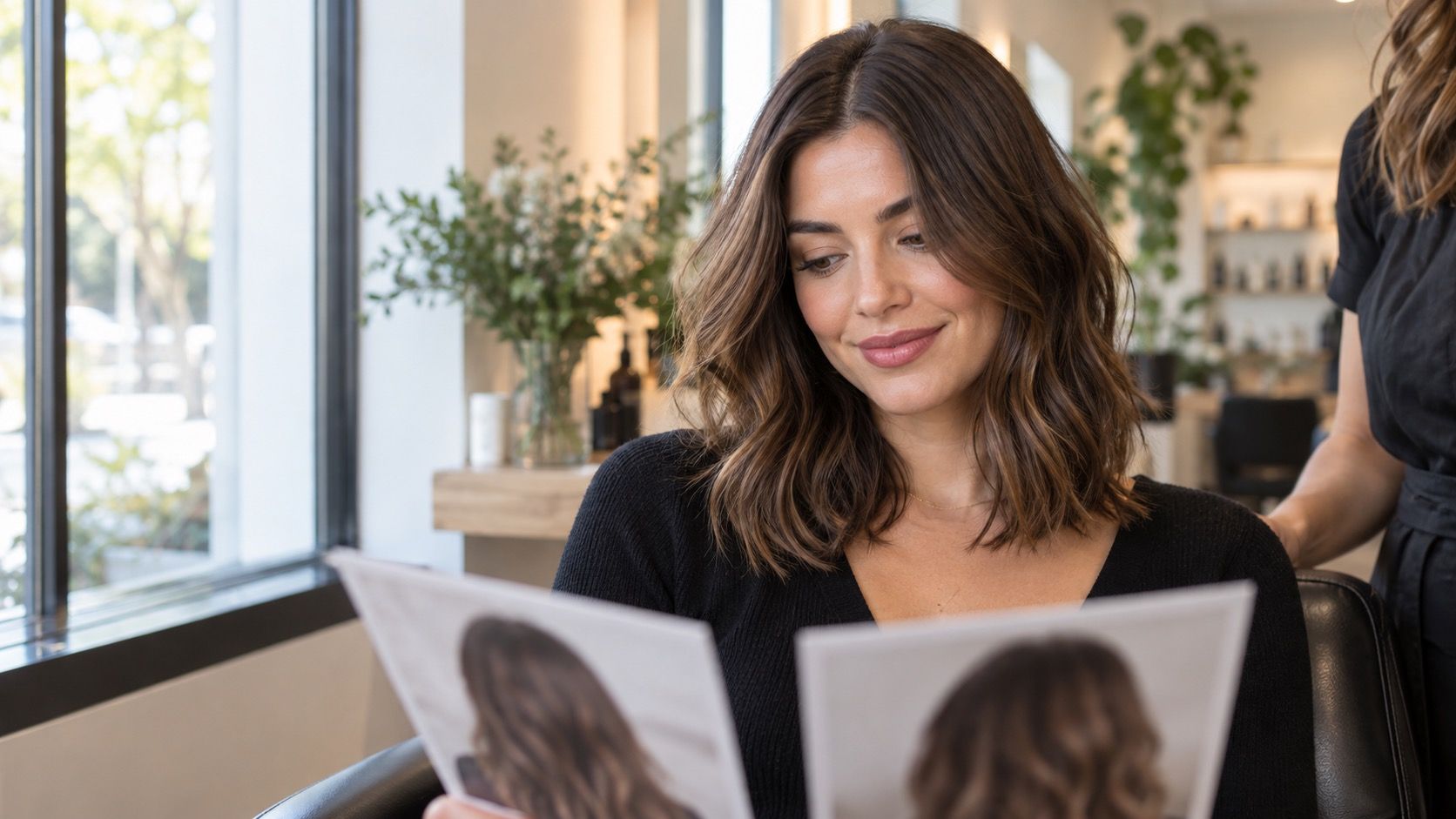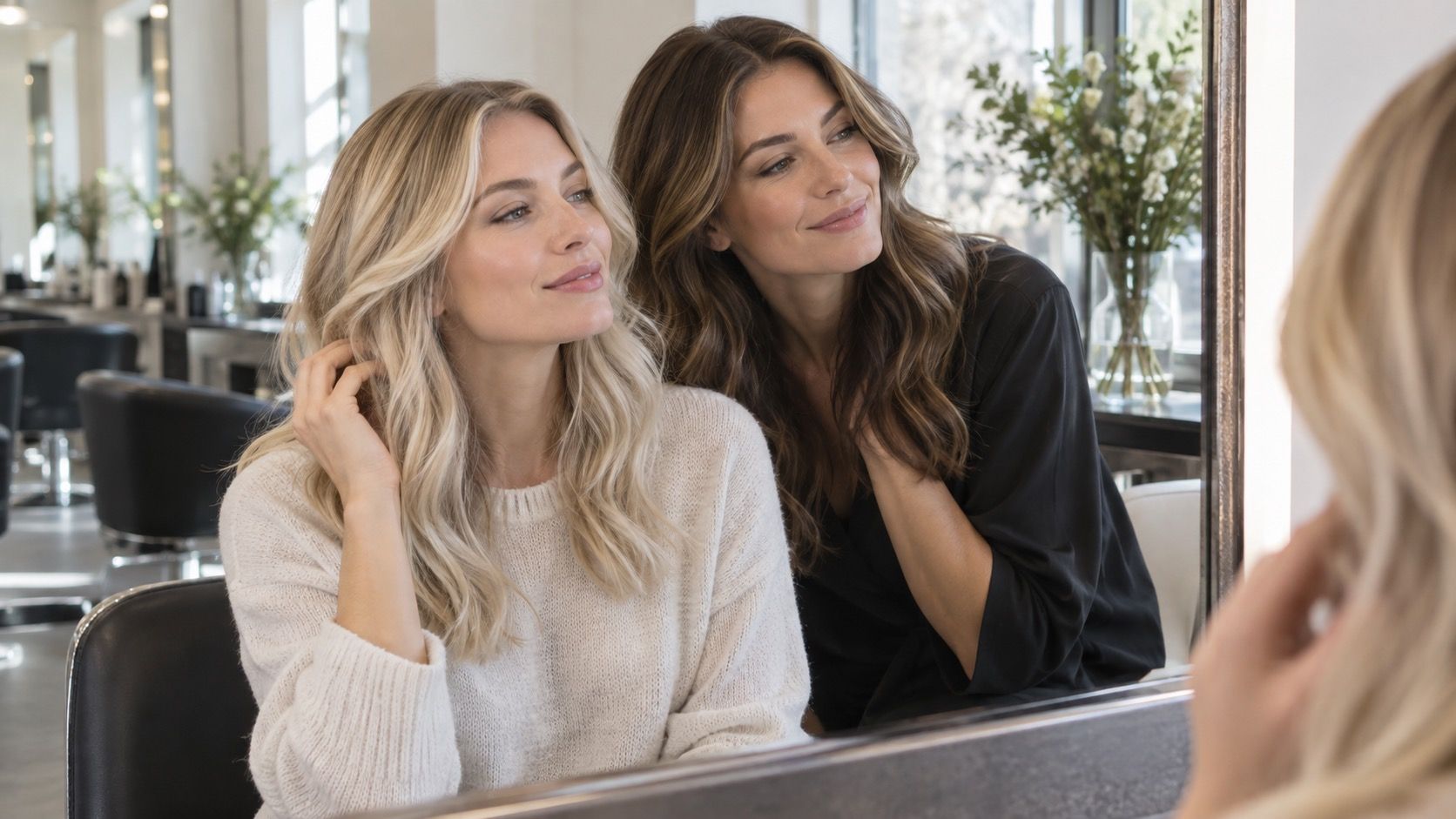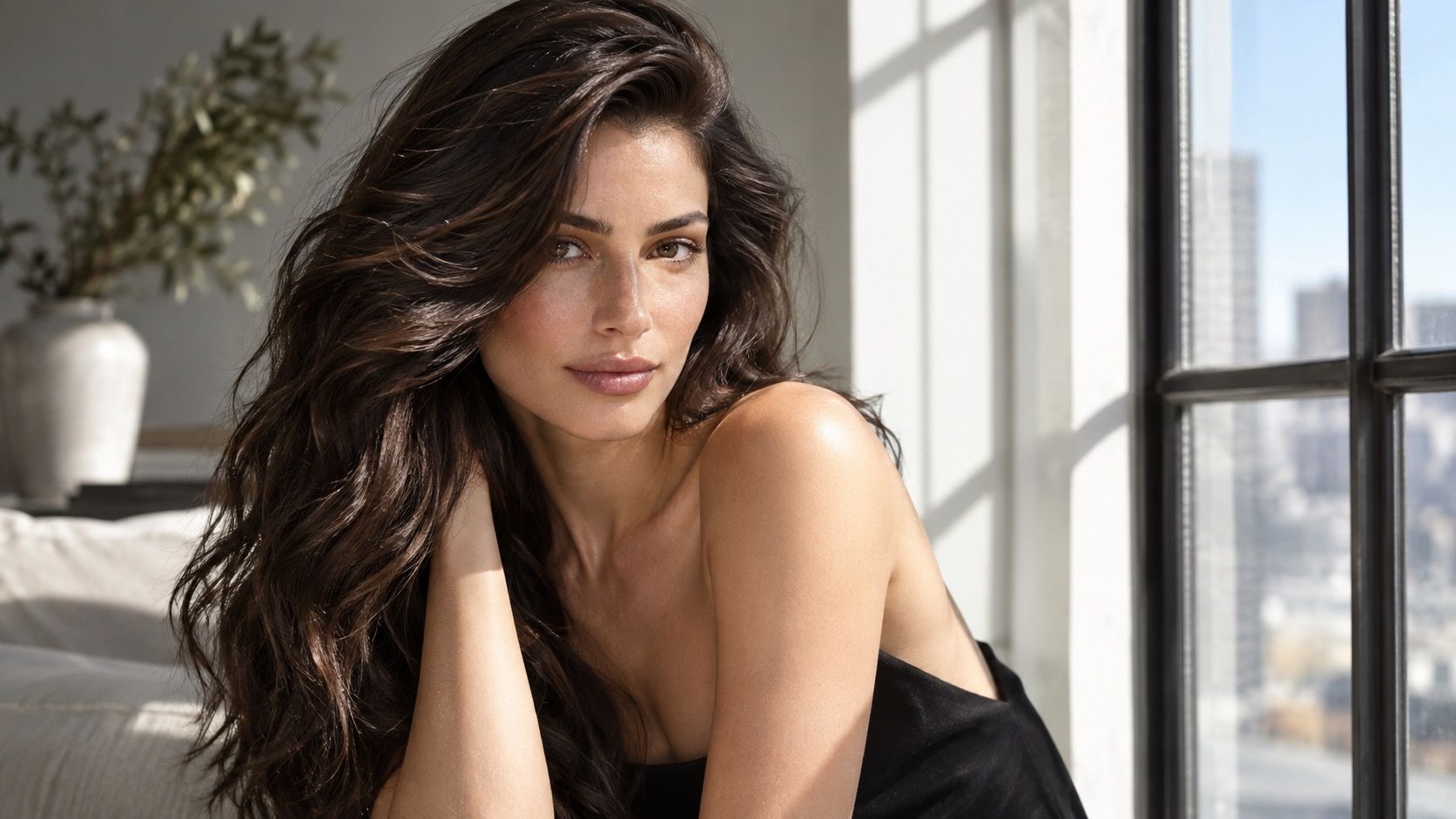
Cool Winter hair colors are often reduced to a row of dark swatches, which is how people end up with a shade that is technically cool but strangely lifeless. The more useful question is whether the color keeps your natural contrast visible: dark lashes beside clear skin, a crisp eye color, or simply features that do not disappear when the hair is deep. Before booking a big change, compare the shade beside an unfiltered daylight photo rather than trusting the tiny salon ring.
Start with clarity, because “cool” alone can make the result look dusty
Cool Winter sits on the cool side of seasonal color analysis, but it also tends to handle clear color better than a muted, smoky finish. Think of the difference between a clean navy sweater and a heathered blue-gray one. Both are cool; one makes the face look defined, while the other can pull the same face toward tired. That distinction matters more than whether a formula has the word ash on the tube.
Use a simple mirror check in indirect daylight. Hold a cool black fabric, a charcoal fabric, and a soft mushroom-brown fabric near the jawline. If cool black gives your eyes and skin a sharper outline while charcoal seems to settle over them, a clearer direction is usually safer. This is not a diagnosis, and lighting can mislead, but it is a better starting point than choosing by a celebrity photo taken under studio lamps.
A common salon problem is overcorrecting brass with too much gray or blue-violet toner. The first few days can look impressively icy, then the finish reads flat once the gloss fades. Ask to see the proposed level and tone against your natural root. A Cool Winter-friendly result should look deliberate and polished, not like color that has been left to oxidize.
Choose deep brunette when your natural root already carries the contrast
For many people in this direction, the easiest win is not a dramatic transformation at all. A deep espresso, cool dark chocolate, or soft black-brown can preserve the darkness around the face without making the hair look inky. It is especially useful when the natural root is medium-to-dark brown and the brows are visibly deeper than the skin. In that situation, lifting everything to blonde often creates more maintenance than harmony.
Bring two reference images to the consultation: one with a reflective, cool brunette in daylight and one that shows the same sort of shade indoors. Salon photos can hide a warm red cast until the client walks outside. Ask whether the formula relies on permanent dye, a demi-permanent gloss, or lowlights over an existing lighter base. A gloss is a sensible trial when you are unsure about going darker, although it will not behave like a permanent color on porous ends.
Blue-black is the bold end of this family. It can be striking on naturally very dark hair, strong brows, and clearly contrasted features, but it is less forgiving than a deep espresso. The caveat is practical: removing dark artificial pigment later is a project, not a casual Saturday decision. If your hair is currently highlighted or lightened, have a strand test done before committing; dark color can grab unevenly on pale, porous pieces.
| Direction | When it usually works | What to check first |
|---|---|---|
| Deep espresso | You have a dark or medium-dark root and want more polish | Look for a cool reflection without an obvious gray veil |
| Cool black or blue-black | Your natural features stay visible beside very dark fabric | Do a strand test and discuss the difficulty of future removal |
| Cool medium brown | You want contrast but black feels too severe | Keep dimension near the face so it does not read as one flat block |
| Platinum or icy blonde | You can support a light, clear result with strong brows and contrast | Assess hair condition and the realistic root-maintenance schedule |
Go bright blonde only when the lightness still looks crisp beside your features
Icy blonde is often placed on every Cool Winter palette, but it is not an obligation. The useful version is pale, cool, and luminous rather than beige, yellow, or heavily smoked out. If a silver-white scarf makes your eyes look awake and your complexion look even, a light direction may be worth trying. If it makes you notice every bit of redness or under-eye shadow, dark brunette may be doing the stronger job.
There is also a technical reality behind platinum. Reaching a clean pale level usually requires controlled lightening, and the result depends on previous color, density, and the condition of the ends. A careful colorist should talk about the number of sessions, a test strand, and what happens if the hair does not lift evenly. Do not treat a cool toner as a repair product; it adjusts visible tone, but it cannot make fragile hair behave like untouched hair.
Root contrast can make the blonde more convincing, not less. A softly shadowed cool root lets the face keep its natural depth and makes regrowth less abrupt. What usually goes wrong is a warm, beige root paired with icy lengths. In a daylight photo, that small warmth is what the eye reads first. Ask for a cool root melt and view it outdoors before deciding whether the tone needs more depth.
Prevent the gray cast with shine and controlled dimension
The fear of “going gray” is usually not about gray hair. It is about a low-saturation finish that drains the color from the face. Cool does not need to mean matte. A reflective gloss, subtle lowlights, or a few cleaner ribbons around the face can keep a dark color from looking like a solid helmet and can stop blonde from turning chalky.
Check the color at three distances: close to the mirror, at arm’s length, and in a quick phone photo near a window. At arm’s length, the hair should frame the face rather than make the face look separate from it. In the photo, watch the skin around the mouth and eyes. If a new ash shade makes those areas look shadowed, the formula may be too muted, too dark, or simply too cool for the exact level.
Maintenance products can also muddy the result. Purple shampoo is useful when pale hair turns yellow, but frequent use can leave porous ends dull or lavender-gray. Use it only as needed and alternate with a moisturizing wash. For brunette shades, a cool-toned gloss between appointments is often more predictable than repeatedly layering box dye. If you color at home, follow the product instructions, patch test in advance, and do not use permanent color as a quick correction for a toner problem.
Keep red, burgundy, and fashion shades blue-based and clean
Cool Winter can often carry stronger red than softer seasonal groups, provided the color stays away from copper and orange. Cool burgundy, black cherry, wine red, and blue-violet can work because they echo the depth and clarity of a cool palette. In a salon book, compare true berry references with auburn references side by side; the names are unreliable, while the underlying warmth is not.
The practical risk is fade. Many vivid reds fade warmer than the appointment-day result, particularly on pre-lightened hair. Ask what the color will look like after several washes and whether the maintenance gloss contains enough cool pigment to offset that shift. A temporary color mask or a small hidden panel can be a low-commitment way to test whether burgundy feels exciting or overwhelms your usual wardrobe.
For blue, violet, or nearly-black fashion color, remember that contrast is still the point. A richly pigmented shade can look elegant; a washed-out smoky violet may have the same gray-cast problem as an over-toned blonde. Photograph it with the clothes you actually wear. If your reliable black, white, cobalt, or berry pieces suddenly look more convincing, that is useful evidence.
Plan the upkeep before a high-contrast appointment, not after it
High-contrast hair is less about a single formula than the gap between appointments. A deep glossy brunette may need a refresh for shine every few weeks, while an icy blonde often needs careful root work on a tighter schedule. Neither choice is morally better; the right one is the version you can maintain without constantly chasing brass, banding, or dry ends.
Before the service, decide what you will do when the root shows, when the tone warms, and when the lengths feel dry. Ask for a written note of the color family and level used, take a daylight photo on the day, and save it next to the inspiration image. That record is far more useful at the next appointment than trying to remember whether the previous shade was “a bit cooler.”
A final virtual try-on can help compare the overall direction: deep espresso against cool black, or icy blonde against a cooler medium brown. Treat it as a composition test, not proof of an exact dye result. The best Cool Winter hair color is the one that keeps your face clear in ordinary light, survives your real maintenance routine, and still looks like you rather than a filter.